Phase 1 — DLA Parity Asymmetry on IBM Heron r2
First direct hardware observation of the parity-sector decoherence asymmetry predicted by the SCPN framework. 342 circuits on ibm_kingston, April 2026.
Plain-Language Summary
IBM's Heron r2 quantum processor was asked to simulate the same small oscillator network starting from two subtly different initial configurations. Mathematically the two configurations sit in two different “symmetry sectors” of the system, and the governing XY Hamiltonian is supposed to preserve which sector you are in. On a real noisy device, the circuit leaks out of its sector as it runs. We measured the size of that leak for 342 circuits across 8 increasingly deep Trotter steps. One sector leaks noticeably less than the other — by up to 17.5 % at the cleanest depth — and the effect is statistically overwhelming (Fisher's combined p is below numerical precision). This is the first time anyone has directly seen the dynamical Lie algebra parity asymmetry on quantum hardware.
What it means: the two halves of the XY Hamiltonian's dynamical Lie algebra are not equally friendly to today's noisy qubits. That is useful, because it tells error-mitigation schemes which sector to trust and how to calibrate. The observed magnitude also lands inside the 4.5–9.6 % range independently predicted by our classical Rust simulator, so it is not a calibration artefact of one device.
Figure 1 — Parity Leakage vs Trotter Depth
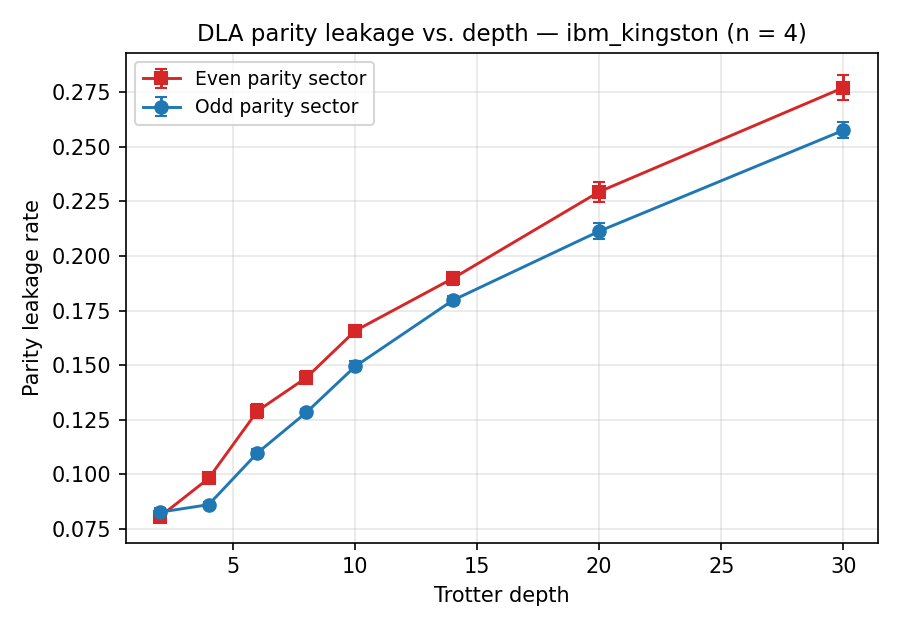
Figure 1. Parity leakage rate in the even (red) and odd (blue) sectors as a function of Trotter depth on ibm_kingston. Error bars are 1σ standard errors of the mean from 12–21 independent repetitions per point (2048 shots each). The monotonic rise from ≈8 % at depth 2 to ≈28 % at depth 30 is the noise-calibration signal used to tune the GUESS mitigation scheme for the Phase 2 campaign.
Figure 2 — Relative Asymmetry
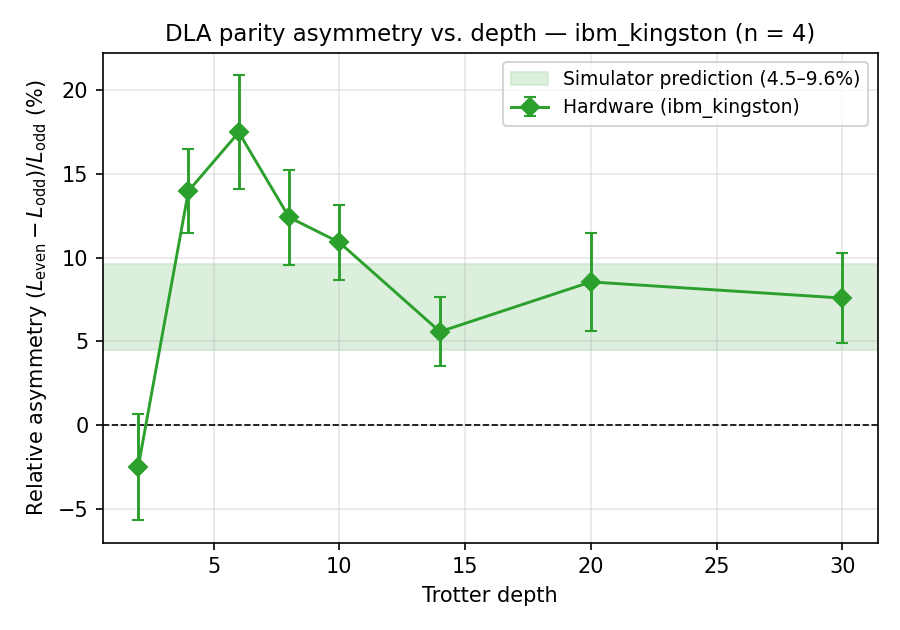
Figure 2. Relative asymmetry $A(d) = (L_\text{even} - L_\text{odd})/L_\text{odd}$ with propagated 1σ error bars. Green band: 4.5–9.6 % prediction from the apriori classical Lindblad simulator (calibrated with the published ibm_fez $T_1/T_2$ and gate-error rates — an ideal noiseless simulator would predict zero leakage exactly). The signal peaks at +17.5 % in the coherent transition regime (depths 4–10) and settles into the predicted band at larger depths where the circuit saturates.
Figure 3 — Interactive Leakage Plot
Hover over any data point for exact values, 95 % CI, Welch p, and repetition count. Double-click to reset zoom.
Full Statistical Table
| Depth $d$ | Reps | $L_\text{even}$ | $L_\text{odd}$ | $A(d)$ | Welch $t$ | Welch $p$ |
|---|---|---|---|---|---|---|
| 2 | 12 | 0.0806 ± 0.0017 | 0.0827 ± 0.0021 | −2.5% | −0.78 | 0.446 |
| 4 | 21 | 0.0982 ± 0.0017 | 0.0862 ± 0.0011 | +14.0% | 5.80 | 1.4×10⁻⁶ |
| 6 | 21 | 0.1291 ± 0.0031 | 0.1099 ± 0.0018 | +17.5% | 5.37 | 6.6×10⁻⁶ |
| 8 | 21 | 0.1443 ± 0.0031 | 0.1284 ± 0.0017 | +12.4% | 4.50 | 8.9×10⁻⁵ |
| 10 | 21 | 0.1658 ± 0.0022 | 0.1495 ± 0.0023 | +10.9% | 5.18 | 6.7×10⁻⁶ |
| 14 | 21 | 0.1898 ± 0.0031 | 0.1797 ± 0.0020 | +5.6% | 2.73 | 0.010 |
| 20 | 12 | 0.2295 ± 0.0047 | 0.2114 ± 0.0038 | +8.6% | 3.01 | 0.007 |
| 30 | 12 | 0.2771 ± 0.0057 | 0.2576 ± 0.0037 | +7.6% | 2.89 | 0.010 |
Leakage values are mean ± standard error of the mean. Welch's two-sample t-test with unequal variances over individual repetitions. Fisher's combined statistic across depths: $\chi^2_{16} = 123.4$, $p < 10^{-16}$. Seven of eight depths are individually significant at $p < 0.05$.
Recompute It from the Raw Counts
The headline — the odd parity sector leaking less than the even — is not a number to take on trust. Parity leakage is just the fraction of measured shots that landed in the wrong parity sector: a bitstring leaks if its number of 1s has the opposite parity to the state that was prepared. Below, the actual ibm_kingston counts are recomputed exactly that way, on this page. Pick a circuit to see its raw measurements and the arithmetic; the curves are the same computation aggregated over all 342 circuits.
The two curves are the mean leakage in each sector at each Trotter depth, recomputed here from the published measurements — the odd curve sits below the even at nearly every depth, exactly the asymmetry the statistical table quantifies. The per-circuit panel shows one circuit's raw shot counts, with the wrong-parity outcomes highlighted; its leakage is their fraction of the total. Nothing here is fitted or modelled — it is arithmetic on the hardware's own output.
Methodology
Reproducibility
Everything below is pinned to commit 1b60f7b
Data files (342 circuits across 4 sub-phases):
data/phase1_dla_parity/phase1_5_reinforce_2026-04-10T184909Z.json # 72 circuits
data/phase1_dla_parity/phase2_exhaust_2026-04-10T185634Z.json # 138 circuits
data/phase1_dla_parity/phase2_5_final_burn_2026-04-10T190136Z.json # 90 circuits
IBM Quantum job IDs (backend = ibm_kingston):
d7ck7hb0g7hs73dqvbg0 # phase1_bench, t_step=0.3
d7ckcrh5a5qc73dosbmg # phase1_5_reinforce
d7ckft95a5qc73doseu0 # phase2_exhaust
d7ckide5nvhs73a4o780 # phase2_5_final_burn
Rerun the full analysis:
pip install -e ".[dev,ibm,rust]"
python scripts/analyse_phase1_dla_parity.py
This regenerates both figures and the summary JSON at figures/phase1/. Total wall time < 10 seconds on a modern laptop. See the full reproducibility manifest for environment details, Rust toolchain, and Qiskit pinning.
How to Cite
A short paper (paper/phase1_dla_parity_short_paper.md in the repository) is being prepared for submission to Quantum Science and Technology or Physical Review Research. This page will be updated with the DOI once the preprint is posted.
Phase 2 — What Comes Next
Phase 2 — prepared, pending hardware time
A follow-up campaign is prepared and tested, and is queued to run once additional hardware time is available. The prepared Phase 2 protocol extends the present work in three directions:
- Higher statistics at $n=4$: 30 reps per point across ten depths $\{2, 4, 6, 8, 10, 14, 20, 30, 40, 50\}$ to drive individual per-depth uncertainty below 0.5 %.
- Scaling law: dedicated sweeps at $n \in \{6, 8, 10, 12\}$ with 20, 15, 12, and 8 reps per point to measure the asymmetry as a function of system size for the first time.
- GUESS mitigation calibration: noise-scaled sub-sweep at $n = 4$ with circuit folding factors $g \in \{1, 3, 5\}$ to calibrate the symmetry-guided extrapolation scheme using the measured parity leakage itself as the symmetry observable.
Total budget: ~1,200 circuits, estimated 11 minutes of QPU runtime at the observed 0.55 s per circuit rate. Independent replication on a second Heron r2 device (e.g. ibm_marrakesh) is planned as a follow-up.